EN
 SP
 FR

- Home
- About Us
- Products
- Service
- Project
- News
- Contact Us
Pulished on Oct. 27, 2026
Chain link fence is widely used for industrial properties, warehouses, farms, sports facilities, construction sites, and residential boundaries. Its relatively simple construction makes it a practical fencing option, but the final price can vary considerably from one project to another.
Why can two chain link fence quotations look similar while their prices are significantly different? The answer often lies in details such as wire diameter, mesh opening, coating thickness, fence height, post specifications, accessories, and delivery terms.
For importers, wholesalers, contractors, and project developers, understanding these cost factors is essential for comparing suppliers and protecting profit margins.
This guide explains how chain link fence costs are calculated, which specifications influence the price most, and how to estimate the total purchasing cost when sourcing directly from a manufacturer.
1. How Much Does Chain Link Fence Cost?
There is no single price for all chain link fence products. A lightweight galvanized mesh roll and a complete heavy-duty perimeter fencing system are different products, even if both are described as chain link fence.
The cost depends on what the quotation includes.
Product or supply scope
Main cost factors
Chain link mesh rolls only Wire diameter, mesh opening, height, roll length, coating and material grade
PVC-coated chain link mesh Core wire diameter, coating thickness, finished wire diameter and color
Complete fence panels or sections Mesh specifications, frame design, dimensions and fabrication
Complete fencing system Mesh, posts, rails, tension wire, fittings, fasteners and gates
Installed fencing project Materials, labor, equipment, ground conditions, foundations and local requirements
Imported bulk order Product cost, packaging, inland transport, freight, insurance, customs charges and delivery terms
When requesting a quotation, first determine whether you are buying mesh only, a set of fence components, or a complete installation-ready system.
This distinction is the starting point for every meaningful price comparison.
2. Seven Factors That Determine Chain Link Fence Price
2.1 Wire diameter
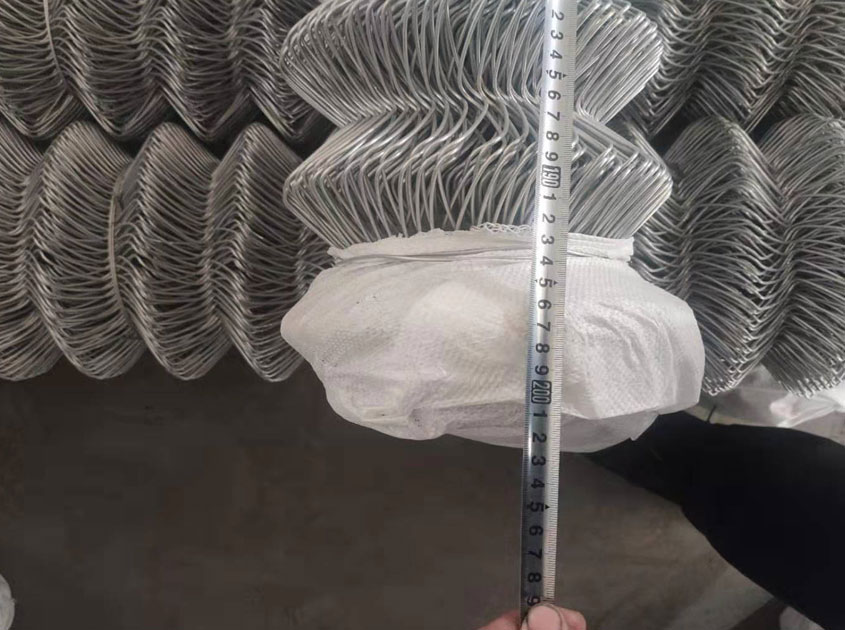
Wire diameter is one of the most important cost drivers because it affects steel consumption and the physical characteristics of the mesh.
For otherwise comparable products, thicker wire generally requires more raw material and may increase manufacturing costs. It can also affect rigidity, handling, and suitability for different applications.
However, wire diameter should not be evaluated in isolation. Two meshes with the same diameter can have different prices because their mesh openings, roll dimensions, coatings, and manufacturing requirements differ.
When comparing quotations, confirm whether the stated diameter refers to the bare steel wire or the finished PVC-coated wire.
2.2 Mesh opening
Mesh opening refers to the size of the spaces between adjacent wires. Commonly available configurations vary by manufacturer and market.
Smaller openings may require more wire per unit area, depending on the wire diameter and mesh construction. Larger openings may reduce material consumption but may not meet the same containment, screening, or security requirements.
Buyers should also confirm the measurement convention. A supplier may describe an opening using the clear distance between wires or another specified measurement method.
Never compare two quotations based on the mesh opening alone without confirming how it is measured.
2.3 Fence height and roll length
A taller fence uses more mesh material per linear meter of fence. Longer rolls may reduce the number of joints in certain applications, but their handling, storage, and transportation requirements should also be considered.
For a basic mesh-only estimate:
Required mesh area = Fence length × Fence height
For example, a project requiring 100 meters of mesh at 2 meters high has a nominal mesh area of 200 square meters, before allowing for waste, overlaps, gates, or other installation details.
This calculation provides a starting point for quantity planning, not a complete fence-system estimate.
2.4 Galvanized or PVC-coated finish
The surface treatment can significantly affect the quotation.
Galvanized chain link fence uses a zinc coating to help protect the underlying steel from corrosion. The production method, zinc coating specification, and whether galvanizing occurs before or after weaving can affect cost and performance.
PVC-coated chain link fence adds a polymer layer over the wire. Its price depends on factors such as the underlying wire, coating process, finished diameter, color, and required quality controls.
A PVC-coated product is not automatically equivalent to a galvanized product with the same stated diameter. The steel core and the outer coating should be specified separately where necessary.
For buyers, the right comparison is not simply “galvanized versus PVC.” It is whether the proposed material and coating meet the intended environmental and service requirements.
2.5 Posts, rails and accessories
Mesh is only one part of a complete fence.
A typical chain link fencing system may include:
Line posts and corner or end posts
Top rails and other specified support members
Tension bars and tension bands
Tie wires or clips
Brace bands and rail-end fittings
Gates, hinges, latches and related hardware
Concrete or other specified foundations
A mesh-only quotation can look substantially cheaper than a complete system quotation because it excludes these items.
Before accepting an offer, ask the supplier to list the included components and quantities. If you are purchasing from several suppliers, verify that the parts are compatible in dimensions, connection methods, and finish.
2.6 Order quantity and customization
Manufacturers may offer different pricing for trial orders, standard production runs, and large repeat orders.
Larger quantities can improve production efficiency and distribute certain fixed costs across more units. However, the actual price advantage depends on raw-material prices, production capacity, packaging, customization, and the supplier's order terms.
Non-standard heights, special colors, unusual mesh openings, custom posts, and special packaging may increase costs or require additional production time.
Request a quotation for your actual order quantity rather than assuming that a published sample price applies to bulk purchasing.
2.7 Packaging and delivery requirements
Roll diameter, bundle dimensions, loading arrangements, protective packaging, and container utilization can affect export costs.
Two orders with similar product values may have different freight costs if their packaging dimensions and loading efficiency differ.
For international buyers, it is therefore useful to review both the unit price and the quantity that can be shipped in the planned container or transport arrangement.

3. How to Calculate the Cost of a Chain Link Fence Project
A reliable estimate separates the mesh, supporting components, logistics, and installation costs.
Step 1: Calculate the required mesh quantity
For a straightforward rectangular boundary:
Nominal mesh area = Total fence length × Fence height
Suppose a project requires 250 meters of fence at a height of 1.8 meters.
Nominal mesh area = 250 × 1.8 = 450 square meters.
The purchasing quantity may be higher after considering roll widths, cutting, overlaps, terrain changes, gates, and installation waste. The actual allowance should reflect the site layout and the supplier's roll dimensions.
Step 2: Calculate the mesh material cost
If the supplier quotes by square meter:
Mesh cost = Required mesh area × Quoted price per square meter
If the supplier quotes by roll, calculate the number of rolls required and multiply by the quoted price per roll.
Make sure the quotation specifies the same product dimensions and specifications used in your quantity calculation.
Step 3: Add posts and accessories
Determine the post layout, corner locations, gate openings, bracing requirements, and other system components.
Post spacing should be based on the fence design, loads, terrain, and applicable project requirements rather than an assumed universal spacing.
Add the quoted costs of posts, rails, fittings, gates, fasteners, and any other required components.
Step 4: Add shipping and import-related costs
For imported fencing products, the total cost may include:
Domestic transport to the export port
Export packaging and handling
Ocean or other international freight
Cargo insurance, if required
Customs duties and import taxes
Customs clearance and destination handling
Inland delivery to the warehouse or project site
The exact charges depend on the destination country, shipment arrangement, customs classification, and agreed Incoterm.
Step 5: Add installation costs where relevant
For a turnkey project, installation expenses may include labor, excavation, post foundations, equipment, terrain preparation, gate installation, and site-specific work.
These costs can vary substantially between locations. A factory-direct material price should not be compared directly with a contractor's installed price unless the scope of supply is equivalent.
4. Factory Price vs. Landed Cost: Which Number Matters Most?
For importers and distributors, the lowest quoted unit price is not necessarily the lowest total purchasing cost.
Consider this simplified comparison. The following figures are illustrative only and are not market quotations.
Cost item
Supplier A
Supplier B
Mesh and specified components $10,000 $10,600
Export and freight-related costs $2,000 $1,500
Destination-related costs $1,000 $1,000
Illustrative total $13,000 $13,100
In this hypothetical example, Supplier A has the lower product price, but its total delivered cost is only slightly lower than Supplier B's.
In another shipment, different freight rates, packaging arrangements, or product specifications could reverse the result.
The figures above do not represent typical chain link fence prices. Their purpose is to demonstrate why buyers should calculate the full cost using comparable quotations.
For a meaningful comparison, confirm:
Identical wire diameter and mesh opening
Equivalent coating specifications
The same fence height and roll length
Matching accessory and post quantities
The same order quantity and packaging assumptions
Comparable delivery terms and destination charges
Equivalent quality documentation and inspection scope
Only then can the price difference be evaluated fairly.
5. Hidden Costs That Can Reduce Your Profit Margin
For distributors and project buyers, some costs become visible only after an order is placed.
Specification differences
A low quotation may use a different wire diameter, coating specification, or component thickness. If the products are not equivalent, the apparent savings may be misleading.
Quantity and cutting losses
Roll dimensions may not align with the project layout. Poor planning can result in unnecessary offcuts, extra joints, or additional rolls.
Incomplete component lists
A quotation may cover the mesh but exclude fittings, rails, gates, or other necessary parts. The missing components must be sourced separately, potentially increasing cost and delivery complexity.
Packaging and freight assumptions
Quoted freight estimates may change with shipment volume, route, timing, and cargo dimensions. Confirm what is included and how any additional charges are handled.
Quality and documentation requirements
If a project requires specific test reports, material verification, inspection, or custom packaging, these requirements should be discussed before the order is confirmed.
A detailed quotation is valuable not only because it clarifies price, but because it reduces the risk of unexpected costs after production begins.
6. How to Reduce Chain Link Fence Purchasing Costs Without Sacrificing Quality
The objective should be to optimize the total cost while preserving the fence's required function.
Match the specification to the application. Avoid over-specifying wire diameter, coating, or accessories when they do not improve performance for the intended use. Equally, do not reduce material specifications below project requirements simply to obtain a lower quotation.
Standardize dimensions where practical. Using standard heights, openings, roll lengths, and component designs may simplify production and purchasing.
Consolidate compatible orders. Combining requirements across projects may improve production planning or shipping efficiency, depending on order timing and logistics.
Compare complete quotations. Ask each supplier to quote the same technical specification and delivery basis.
Plan the shipment before finalizing the order. Confirm packaging dimensions, roll quantities, loading arrangements, and destination requirements early enough to avoid preventable changes.
Evaluate repeat-order consistency. For distributors, consistent specifications and reliable documentation can be more valuable than a small initial price difference.
These methods help buyers reduce avoidable costs without compromising the quality needed for the project.
7. What Information Should You Send a Chain Link Fence Manufacturer?
A clear inquiry makes it easier for a manufacturer to prepare an accurate quotation and identify missing details.
Use this checklist when contacting a supplier:
Product: Chain link mesh only or complete fence system
Quantity: Total linear meters, roll count, or required area
Fence height: Required finished height
Roll length: Preferred length, if purchasing mesh rolls
Mesh opening: Required opening dimensions and measurement method
Wire diameter: Bare core diameter or finished coated diameter, as applicable
Surface treatment: Galvanized, PVC-coated, or another specified finish
Posts and accessories: Required types, quantities, and dimensions
Application: Warehouse, farm, sports facility, construction site, industrial boundary, or another use
Destination: Country, port, or final delivery location
Delivery terms: For example, EXW, FOB, CFR, or CIF, where appropriate
Documentation: Any required inspection reports, certificates, or project specifications
If some details are not yet decided, provide the intended application, approximate quantity, and destination first. The supplier can then help clarify the technical options before the final quotation is prepared.
Frequently Asked Questions
Is chain link fence cheaper than welded wire fence?
It depends on the specifications and scope of supply. Mesh dimensions, wire diameter, coating, post systems, accessories, and installation requirements all affect the comparison. Compare products with equivalent performance requirements and included components.
Does thicker wire always mean a better chain link fence?
Not necessarily. Thicker wire generally uses more material, but suitability also depends on mesh opening, fence design, support structure, exposure conditions, and intended use. The correct specification should be based on the project's requirements.
Is PVC-coated chain link fence more expensive than galvanized chain link fence?
PVC-coated products may cost more because they require an additional coating process and associated materials. The actual difference depends on the core wire, finished diameter, coating specifications, color, quantity, and supplier.
Can I purchase chain link mesh without posts and accessories?
Yes. Mesh-only orders are common for distributors, fabricators, and contractors who source their own posts and hardware. Make sure the mesh dimensions and connections are compatible with the supporting system.
How can I compare quotations from different Chinese manufacturers?
Prepare one common specification sheet and request quotations on the same basis. Compare the material details, product dimensions, coating, quantity, packaging, included accessories, quality documents, delivery terms, and estimated landed cost.
Does a larger order always result in a lower unit price?
No. Larger orders may improve production efficiency, but pricing also depends on raw materials, customization, production schedules, packaging, and freight. Request volume-based quotations to identify the actual price difference.
Conclusion
The cost of chain link fence is determined by more than its price per meter or roll. Wire diameter, mesh opening, coating, fence dimensions, supporting components, order quantity, packaging, shipping, and installation all contribute to the final budget.
For importers, wholesalers, and contractors, the most effective purchasing strategy is to compare equivalent specifications and calculate the total cost relevant to the project.
Linkland Fence supplies chain link mesh and fencing products for international buyers. To request a quotation, share your required dimensions, wire diameter, mesh opening, surface treatment, order quantity, and destination. This information helps establish a more accurate price and a clearer basis for comparing offers.
Previous: None
Next: How to Install a Welded Wire Fence: A Step-by-Step Guide for Contractors
How Much Does Chain Link Fence Cost? A Complete Guide to Material Prices, Shipping and Project Costs
Pulished on Oct. 27, 2026
How to Install a Welded Wire Fence: A Step-by-Step Guide for Contractors
Pulished on Oct. 23, 2026
358 Fence vs Welded Wire Fence: Which Is Better for Your Project?
Pulished on Oct. 20, 2026
What Are the Advantages of Chain Link Fence? 8 Benefits for Commercial and Industrial Projects
Pulished on Oct. 16, 2026
How to Choose Farm Fence for Cattle and Horses: Wire, Height and Design Guide
Pulished on Sep. 23, 2026
How Is Chain Link Fence Made? Manufacturing Process and Components
Pulished on Sep. 18, 2026
358 Security Fence vs Chain Link Fence: Security, Cost and Application Comparison
Pulished on Sep. 15, 2026
Why Choose Welded Wire Fence for Security and Protection?
Pulished on Sep. 07, 2026
How Much Does Chain Link Fence Cost? A Complete Guide to Material Prices, Shipping and Project Costs
Pulished on Oct. 27, 2026
How to Install a Welded Wire Fence: A Step-by-Step Guide for Contractors
Pulished on Oct. 23, 2026
358 Fence vs Welded Wire Fence: Which Is Better for Your Project?
Pulished on Oct. 20, 2026
What Are the Advantages of Chain Link Fence? 8 Benefits for Commercial and Industrial Projects
Pulished on Oct. 16, 2026
How to Choose Farm Fence for Cattle and Horses: Wire, Height and Design Guide
Pulished on Sep. 23, 2026
How Is Chain Link Fence Made? Manufacturing Process and Components
Pulished on Sep. 18, 2026
358 Security Fence vs Chain Link Fence: Security, Cost and Application Comparison
Pulished on Sep. 15, 2026
Why Choose Welded Wire Fence for Security and Protection?
Pulished on Sep. 07, 2026